Blog
Minibus vs. Rental Car for Group Travel in Istria: What Actually Saves You Money?
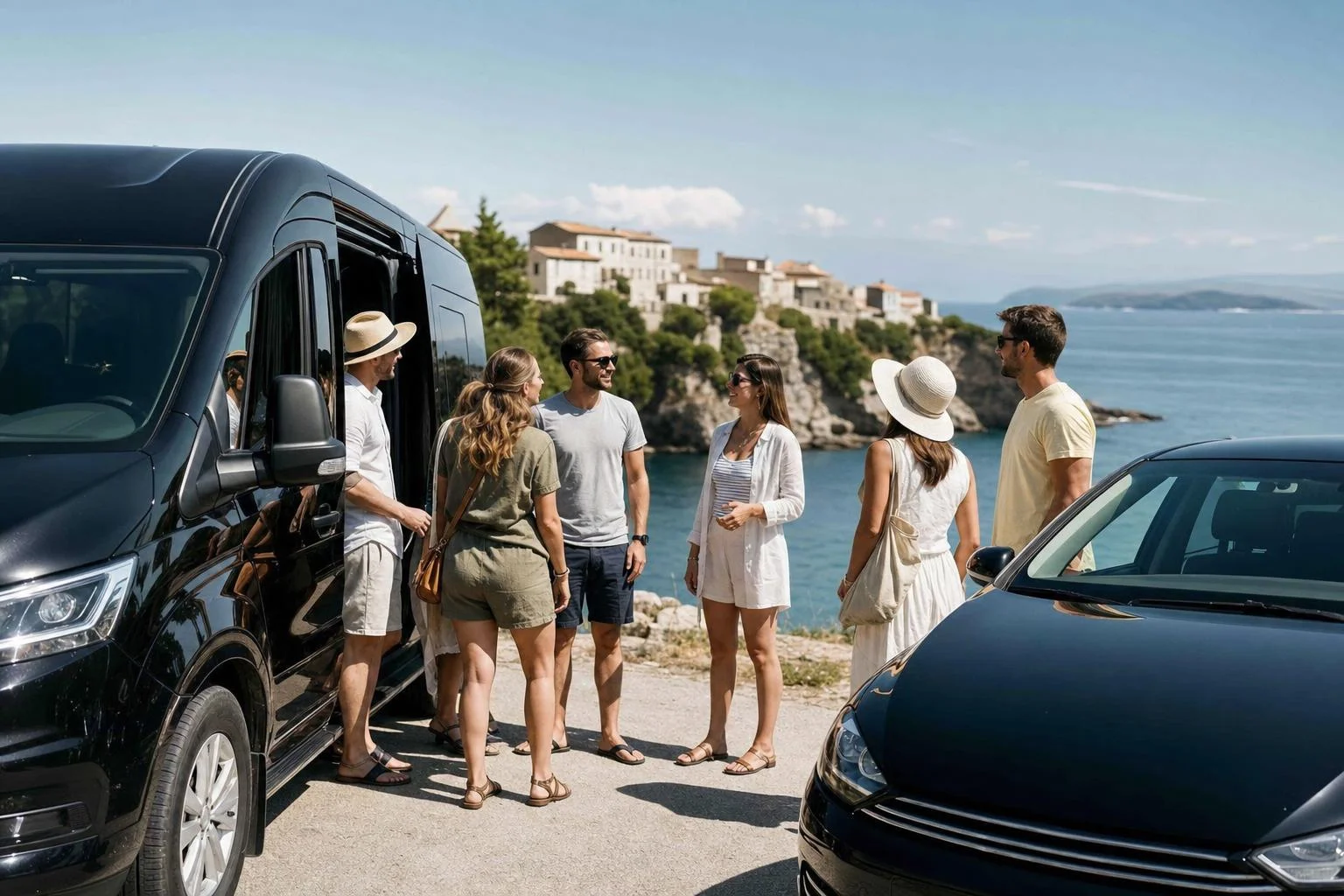
Istria is one of the most rewarding regions to explore as a group — rolling vineyards, hilltop towns, Roman ruins and a coastline that never seems to end. But before the first plate of truffle pasta lands on the table, most groups face the same logistical headache: do we rent a couple of cars, or do we book a minibus transfer? On the surface, splitting a rental car looks like the thrifty option. Dig a little deeper into the real numbers, however, and the picture changes considerably. This article breaks down every significant cost and practical factor so your group can make a genuinely informed decision — not one based on a misleading headline price.
The Headline Price Trap: Why Rental Cars Look Cheaper Than They Are
Every comparison has to start with the sticker price, because that is what most groups look at first. A standard seven-seat MPV in Istria during summer season can appear attractively priced per day when you divide that number across seven people. But rental car pricing in Croatia during peak tourism months is almost never the whole story — and the gap between the quoted rate and the final invoice can be startling.
The base rental rate typically excludes collision damage waiver (CDW) excess reduction, theft protection, a second driver fee if more than one person needs to share driving duties, and a young driver surcharge if anyone behind the wheel is under 25. These extras are not optional in any practical sense; driving an uninsured rental car on Istrian roads with their mix of narrow coastal lanes, construction diversions and heavy tourist traffic is a genuine financial risk. Once you add all mandatory and near-mandatory extras, the daily cost per vehicle can rise by 40 to 70 percent above the advertised figure.
Now multiply that across two vehicles, which is the realistic requirement for a group of eight or more — and suddenly the maths looks very different. Two rental cars mean two sets of insurance upgrades, two fuel tanks to fill, two sets of tolls and two drivers who need to stay sober enough to get everyone home safely from that wine tasting in Motovun.
Fuel, Tolls and Parking: The Costs That Add Up Kilometre by Kilometre
Fuel prices in Croatia fluctuate with European market rates and tend to be broadly comparable to other EU countries, which means a full tank in a seven-seat diesel or petrol MPV is not a trivial expense. A typical group itinerary around Istria — say, Pula to Rovinj, on to Poreč, then inland to Motovun and back — comfortably covers 150 to 200 kilometres depending on route choices and detours. For two vehicles, that translates to a meaningful fuel bill that many groups simply forget to budget for when comparing options online.
Tolls on the Istrian Y motorway (Istarski ipsilon) are charged per vehicle and per section. Groups driving between Pula, the interior and the northern part of the peninsula will pass through toll points multiple times across a multi-day trip. Again, two vehicles means every toll is paid twice. It is not a catastrophic expense in isolation, but layered on top of fuel and insurance upgrades, it compounds quickly.
Parking is perhaps the most underestimated expense of all. The historic cores of Rovinj, Poreč and Pula are pedestrian zones, which means vehicles must be left in paid car parks on the outskirts and the group walks or takes another form of transport into the centre. During July and August, parking fees in these areas are at their highest, and spaces can be scarce enough that drivers spend 20 to 30 minutes circling before finding one. Two cars mean two parking fees at every stop — and the time lost hunting for spaces comes directly out of your sightseeing day.
There is also the matter of fuel card complexity. Some rental companies charge a refuelling fee if the car is returned below full, and calculating exactly how much fuel to put in to return it precisely full is harder than it sounds, especially when you are rushing to catch a return flight. These small charges — five, ten, fifteen euros — accumulate into a sum that nobody anticipated when they booked.
Driver Licensing Requirements in Croatia: A Critical Factor Most Groups Overlook
Croatia recognises EU driving licences, so the basic licensing requirement is straightforward for most European visitors. However, the moment your group considers renting a vehicle with more than eight passenger seats — which is what you genuinely need for nine or more travellers — you move into a different legal category entirely. In Croatia, as across the EU, driving a vehicle in the M2 or M3 category (minibuses with more than eight seats) requires a category D licence. A standard category B car licence does not cover it.
This is not a technicality that rental companies or border police overlook. It is a hard legal requirement with real consequences: driving an unlicensed category of vehicle can result in fines, confiscation of the vehicle and, critically, the complete invalidation of any insurance cover. If an accident occurs while an unlicensed driver is behind the wheel of a vehicle they are not legally permitted to drive, the financial and legal liability falls entirely on that driver — not on the rental company.
For groups of nine to nineteen people, this means one of two things: either you split into multiple smaller cars (with all the associated costs), or you use a professional minibus transfer operated by a driver who holds the appropriate licence. A qualified professional driver with the full range of licence categories can legally operate the vehicle, carry full commercial insurance and take on all the responsibility for safe transit — which is precisely what a licensed transfer provider offers.
Even for groups small enough to fit legally into a single rental MPV, consider that someone in your party has to drive every leg of the journey. That person cannot drink wine at the vineyard, cannot fully enjoy lunch at a konoba, and carries the stress of navigating unfamiliar roads and finding parking while everyone else relaxes. That cost — measured in enjoyment rather than euros — is real, even if it does not appear on any invoice.
What a Professional Minibus Transfer Actually Costs — and What It Includes
When you book a minibus transfer for a group in Istria, you are paying a single, agreed price that covers the vehicle, the driver, fuel, all tolls on the agreed route and the driver's time for the duration of your trip. There is no insurance excess to worry about, no refuelling calculation at the end, no parking fees to split and no designated driver sacrificing their afternoon. The total cost is visible upfront, which makes genuine budget planning possible.
For a group of ten to twelve people, the per-person cost of a minibus transfer often lands within a few euros of what each individual would have paid toward a two-car rental once all the real costs are accounted for — and frequently below it. For larger groups approaching the capacity of a full minibus (up to nineteen passengers), the per-person economics of a transfer become increasingly compelling relative to the alternative of three or four rental vehicles.
Beyond the financial arithmetic, there is practical value in having a driver who knows Istria well. Local knowledge matters on a peninsula where the most interesting destinations — Grožnjan, Oprtalj, the inland Mirna valley — involve single-track roads, blind bends and signage that can confuse even experienced navigators. A professional driver who regularly works these routes knows where to park without paying tourist-zone rates, which roads to avoid during the Motovun Film Festival, and the fastest way back to Pula when the coastal road jams up on a Sunday evening.
One more consideration: accountability and reliability. A transfer that is pre-booked has a professional on the other end of a phone number who is contractually obligated to show up on time. A rental car depends on you being in the right condition to drive at the right moment. When your return journey is timed around a ferry, a flight or a reservation, that reliability has measurable financial value — a missed flight is significantly more expensive than any taxi surcharge.
The Hidden Value of a Stress-Free Journey Through Istria
There is a category of travel cost that rarely appears in any spreadsheet but that seasoned travellers know well: the cost of stress. Navigating an unfamiliar region with a convoy of rental cars introduces a sustained low-grade tension that affects the entire group. Someone is always behind on navigation, the convoy gets separated at a roundabout, one car finds a parking space while the other circles for twenty minutes, and the group reassembles at the destination slightly frayed rather than refreshed.
Istria's road infrastructure is generally good, but the combination of summer tourist volumes, narrow old-town streets, occasional GPS errors on minor rural roads and the pressure of keeping a group schedule creates friction that a self-drive arrangement cannot fully eliminate. A single minibus transfer collapses all of that complexity into one vehicle with one professional managing all route decisions. The group simply travels together, talks, looks out the window and arrives ready to enjoy the destination.
This is particularly relevant for family groups with older members or young children, corporate groups travelling for events or team activities, and any group where individuals have varying levels of comfort with driving in unfamiliar countries. The inclusivity of a single shared vehicle — where no one is left behind, no one is stuck navigating and no one has to forgo a glass of local Malvazija — is a genuine quality-of-life improvement that the headline price of a rental car cannot deliver.
There is also the matter of environmental consideration. One minibus carrying twelve people produces a fraction of the per-person emissions of three rental cars carrying four people each. For groups that factor sustainability into their travel decisions, the minibus option is the more responsible choice — and increasingly, travellers are making that a criterion alongside cost and convenience.
Scenarios Where a Rental Car Genuinely Makes More Sense
An honest comparison has to acknowledge that rental cars are the right choice in some situations. If your group is two or three people, the economics of a private transfer versus a rental car shift, particularly if you plan to cover a lot of ground independently over multiple days and do not have fixed time constraints. For very small groups with flexible schedules and at least one confident driver who knows the region, a rental car can offer spontaneity that a transfer cannot always match.
Rental cars also make sense when your plans are genuinely open-ended — when you want the freedom to stop at a roadside stand, change your itinerary on a whim, or spend an extra hour at a beach without anyone waiting. A pre-booked transfer works to an agreed itinerary and timeline; the freedom of self-drive has real appeal for certain kinds of travellers. The key is to make the decision with full awareness of the actual costs, not the headline daily rate.
A practical middle ground for some groups is to use a minibus transfer for the major logistical legs — arrival, departure, and full-day excursions — while renting a single small car for one or two days of more independent exploration. This hybrid approach captures the comfort and economy of the minibus for the journeys where group cohesion and reliability matter most, while preserving some flexibility for days with looser plans.
How to Make the Comparison Fairly for Your Own Group
The only way to make a genuinely accurate comparison is to build a complete cost model for both options based on your specific group size, itinerary and dates. For the rental car option, start with the base daily rate and then add: full CDW excess waiver, theft protection, second driver fee if applicable, young driver surcharge if relevant, fuel estimate based on planned kilometres, toll costs for your intended routes, and realistic parking fees at each destination. Multiply all vehicle costs by the number of cars you actually need for your group.
For the transfer option, request a quote based on your itinerary. A reputable transfer provider will give you an all-inclusive price covering the vehicle, driver, fuel and tolls for the agreed journey. Divide that by the number of passengers to get your per-person cost, and compare it directly against the per-person total from the rental car model. In most group scenarios of six or more, the comparison is much closer than intuition suggests — and often favours the transfer once all real costs are in the model.
Also consider the non-financial factors: who will drive and how comfortable are they doing so; how important is it that everyone can drink freely at tastings and dinners; how much of the experience depends on the group travelling together rather than in separate vehicles; and how time-sensitive are your arrival and departure logistics. These questions often tip the balance as decisively as the financial calculation.
Finally, book early. Both rental car availability and minibus transfer slots in Istria during peak summer season are genuinely limited, and waiting until the last week before your trip often means higher prices or no availability at all. Whichever option you choose, securing it two to four weeks in advance gives you the best combination of choice, price and peace of mind.
Getting the most out of a group trip to Istria starts long before you arrive — it starts with making the right call on transport. Once you factor in the real costs of fuel, insurance, tolls, parking and driver responsibility, the minibus transfer option holds up far better than the initial rental car quote suggests. If your group is six or more people with a defined itinerary and even one time-sensitive journey, a professional minibus transfer is almost certainly the smarter financial and practical choice. Get in touch with ALP obrt za prijevoz to discuss your group's itinerary and receive a clear, all-inclusive quote — no surprises, no hidden extras, just a reliable ride across Istria.
Frequently asked questions
How many people do you need for a minibus transfer to be cheaper than renting cars in Istria?
As a general rule, once your group reaches six or more people — requiring at least two rental cars when you factor in realistic luggage — a minibus transfer becomes cost-competitive or cheaper when all real rental costs (insurance upgrades, fuel, tolls, parking) are included. For groups of nine or more, the difference is usually clear in favour of the minibus.
Can I drive a minibus rental in Croatia with a standard driving licence?
No. Vehicles with more than eight passenger seats fall into the category D licence class under EU and Croatian law. A standard category B car licence does not permit you to drive them. Operating such a vehicle without the correct licence also invalidates insurance. Only a professionally licensed driver can legally and safely operate a minibus for group transfers.
Are there tolls on the roads in Istria and who pays them in a minibus transfer?
Yes, the Istrian Y motorway (Istarski ipsilon) has toll points on several sections. When you book a minibus transfer, toll costs for the agreed route are typically included in the quoted price — you will not be asked to pay separately at each toll booth. Always confirm this when requesting your quote.
Is parking difficult and expensive in places like Rovinj and Poreč?
In peak summer season, yes. Historic town centres are pedestrian zones, so vehicles park in paid car parks outside the old town. Fees are highest in July and August, spaces fill quickly, and finding a spot can take 20–30 minutes. A minibus transfer drops the group directly at the most convenient point and the driver handles all parking logistics independently.
Ready to find out exactly what a minibus transfer would cost for your group's Istrian itinerary? Contact ALP obrt za prijevoz for a fast, straightforward quote tailored to your journey.
Request a group quote